Playing With Friends: How Play Builds Social Skills in Children
From parallel play at the sandpit to cooperative games on the climbing frame — how children learn to share, negotiate, and make friends through play, and where to practise in Sydney.
You are at the playground and your two-year-old is sitting next to another child at the sandpit. They are not talking, not sharing shovels, barely acknowledging each other. You wonder if something is wrong. It is not. What you are watching is parallel play — and it is one of the most important stages of social development your child will go through.
Play is how children learn to be social. Not through instruction or worksheets, but through the messy, noisy, sometimes tearful business of playing alongside and eventually with other children. The American Academy of Pediatrics calls play “essential to development because it contributes to the cognitive, physical, social, and emotional well-being of children.” Understanding how social play develops helps you support your child at each stage — and worry less when they are not doing what you expect.
The Stages of Social Play
In the 1930s, sociologist Mildred Parten observed children playing and identified stages of social play that researchers still use today. Your child will move through these stages at their own pace, and will return to earlier stages throughout childhood. A seven-year-old who plays cooperatively with friends will still enjoy solitary play with Lego. These stages are not a ladder — they are a toolkit.
Solitary play (birth to 2 years)
Your baby or young toddler plays alone, exploring objects with their hands and mouth. They are learning how the world works — what rattles, what stacks, what rolls. This is not antisocial behaviour. It is the foundation everything else builds on. You will see solitary play continue well beyond toddlerhood, and that is perfectly healthy.
Onlooker play (around 2 years)
Your child watches other children play with interest but does not join in. They might stand near the action, ask questions, or commentate. This looks like hesitation but it is actually research. Your child is observing social rules, figuring out how groups work, and building the confidence to eventually join in. Do not push them — this stage is doing important work.
Parallel play (2 to 3 years)
This is the sandpit moment. Two children sit side by side, doing similar activities, aware of each other but not interacting directly. They might copy each other's actions or choose the same toys. Parallel play is how toddlers learn to be comfortable in the presence of other children. It is the bridge between playing alone and playing together, and it is exactly where most two-year-olds should be.
Associative play (3 to 4 years)
Now your child starts interacting — sharing materials, talking about what they are doing, reacting to each other. But there is no shared goal yet. Two children at a drawing table might swap crayons and chat about their pictures, but they are each drawing their own thing. This stage is where turn-taking, sharing, and basic conversation skills start to click.
Cooperative play (4 to 5 years)
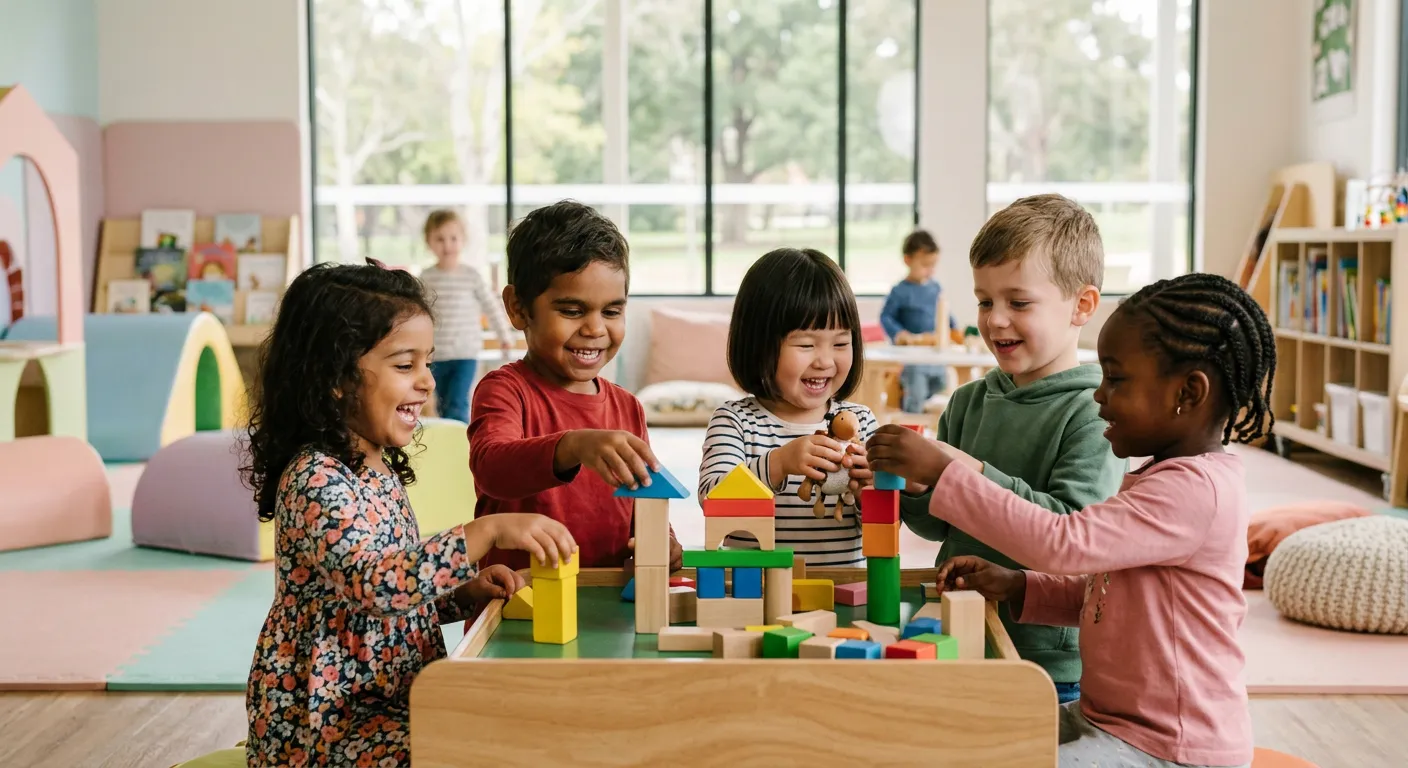
The big milestone. Children play together with a shared goal — they build a cubby, play families, create rules for a game, assign roles. This requires negotiation, compromise, perspective-taking, and emotional regulation. It is complex and it takes years to develop. When you see children arguing about the rules of their made-up game, that argument is the social learning happening in real time.
Parent tip: If your child is still mostly doing parallel play at three, do not worry. The age ranges are averages, not deadlines. Children who attend childcare or playgroups tend to move through these stages earlier because they have more exposure to peers. Children who are primarily at home with a parent may develop cooperative play a little later and that is completely fine.
What Social Skills Does Play Actually Build?
When we say “social skills,” we mean specific, observable abilities that children develop through play interactions. These are not abstract — you can see them happening at the playground, in the play centre, and at home.
Turn-taking and sharing. The slide has one ladder. Two children want to go. This is where turn-taking is learned — not from being told to share, but from the natural consequence of shared equipment. Water tables, ball pits, and climbing structures all create these moments.
Negotiation and compromise.“I want to be the shopkeeper.” “No, I do.” Pretend play forces children to negotiate roles, rules, and storylines. Research from the University of Cambridge found that children who regularly engage in pretend play with peers develop stronger negotiation skills than those who primarily play alone.
Empathy and perspective-taking.When a child plays the role of a baby in a family game or a patient at the doctor's, they practise seeing the world from someone else's point of view. This is theory of mind in action — the understanding that other people have different thoughts and feelings.
Conflict resolution. Arguments during play are not failures — they are practice. When two children disagree about the rules of their game, they are learning to assert themselves, listen to others, and find solutions. These are skills that adults use every day.
Reading body language and social cues. Play teaches children to read non-verbal communication. They learn that a child who turns away might not want to play, that a smile means welcome, and that rough play needs to stop when someone is not laughing anymore. These cues are learned through experience, not explanation.
Activities That Build Social Skills (By Age)
Toddlers (1 to 3 years) — building comfort with other children
At this age the goal is not interaction — it is comfort. You want your toddler to feel safe and relaxed in the presence of other children. Activities that support this include playing at sand and water tables side by side, rolling a ball back and forth with a parent (and eventually another child), simple rhythm activities like banging drums or shaking maracas together, and stacking blocks near another child who is doing the same thing.
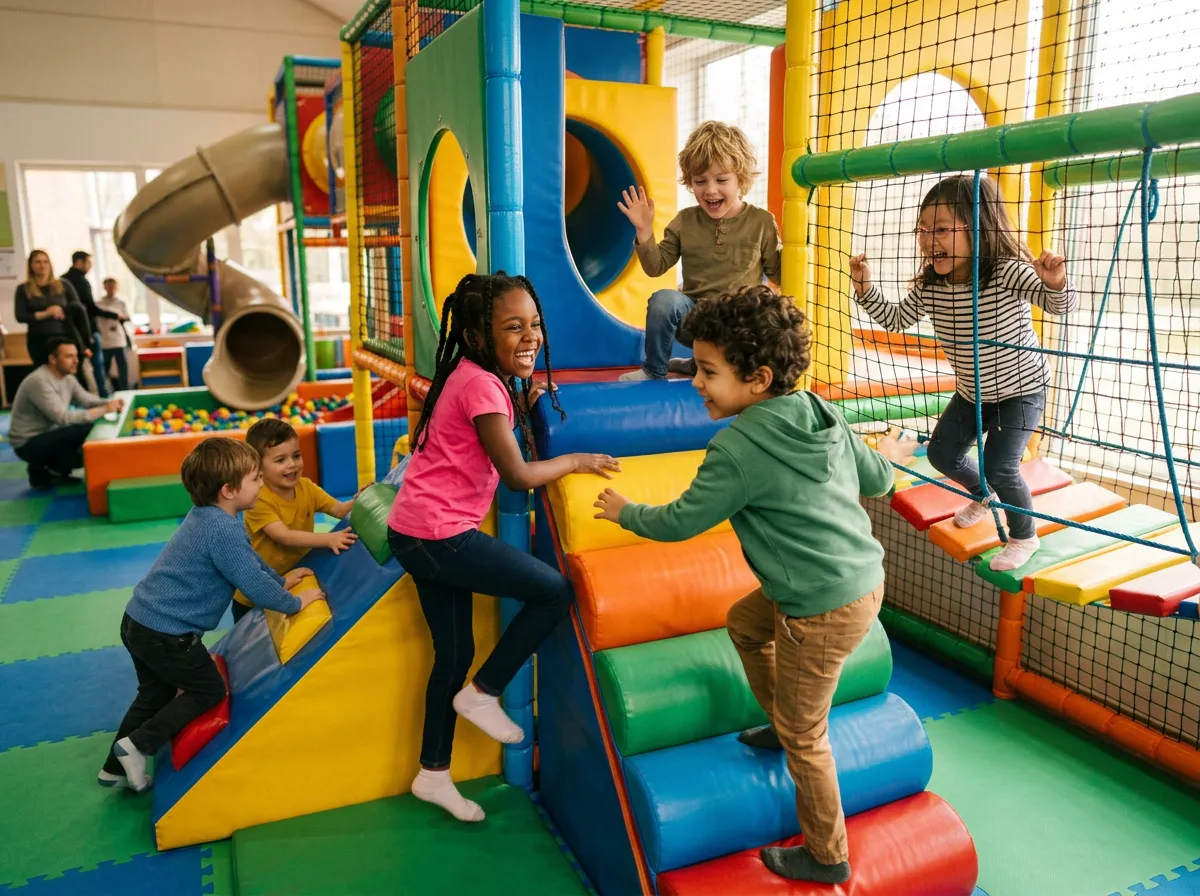
What to try: Soft play centres are excellent for this age because the contained space means toddlers naturally end up near each other in ball pits, tunnels, and padded climbing areas. The shared environment creates parallel play opportunities without any pressure to interact.
Preschoolers (3 to 5 years) — learning to play together
This is when social play really takes off. Preschoolers are ready for activities that involve shared goals and simple rules. Try emotion charades (act out happy, sad, angry and guess the feeling), cooperative building with blocks, boxes, or cushions, role play with a toy kitchen, shop, or doctor's kit, parachute games where everyone lifts and shakes together, and simple obstacle courses where children help each other through.
What to try: Play centres with imaginative play areas — mini supermarkets, construction zones, dress-up corners — are ideal because they provide the props for role play. Children naturally fall into roles and start negotiating who does what. Structured playgroups and library story times also provide guided social interaction with adult support nearby.
School-age (5 to 8 years) — deepening friendships through play
School-age children are ready for complex cooperative play. Team obstacle courses, group art projects, collaborative storytelling, board games with rules, building projects with real tools or large construction sets, and team sports all build on the foundation laid in earlier years. At this age, children start forming genuine friendships based on shared interests and trust.
What to try: Adventure playgrounds and trampoline parks encourage cooperative physical play. Multi-level play structures where children explore together, challenge each other on climbing walls, and create games around the equipment are all opportunities for social skills to deepen. Birthday parties at play venues are also surprisingly effective — the shared excitement and group activities fast-track friendship building.
How to Help a Shy Child Make Friends Through Play
If your child hangs back at the playground or clings to your leg at a play centre, you are not alone. Many children are naturally cautious in social situations and need more time to warm up. This is temperament, not a problem to fix. But there are practical ways to support them.
Start small and familiar. Arrange one-on-one play dates before group settings. Visit the same playground or play centre regularly so your child builds familiarity with the space. Arrive early when venues are quiet so your child can settle in before it gets busy.
Use props as bridges. Bring a ball, bubbles, or chalk to the playground. Shared materials naturally invite other children to approach without your child needing to initiate. A bubble wand is one of the most reliable social ice-breakers for young children.
Narrate without directing.Instead of saying “Go play with that child,” try “That child is building a sandcastle. I wonder what they are making.” This builds your child's awareness without the pressure of a direct instruction to socialise.
Celebrate proximity, not performance. Standing near other children, watching them play, and staying in a busy environment are all wins. Do not measure success by whether your child made a friend today. Measure it by whether they were comfortable being around other children. The friendships will come.
Where to Practise Social Play in Sydney
Different venue types support different stages of social development. Here is how to match the right environment to your child's current stage.
Soft play centres are ideal for toddlers in the parallel play stage. The enclosed, padded spaces mean children end up near each other naturally. Ball pits, tunnels, and low climbing structures create shared experiences without requiring direct interaction. Browse soft play centres in Sydney to find one near you.
Indoor play centres with imaginative play areas are perfect for preschoolers moving into associative and cooperative play. Mini kitchens, dress-up corners, and construction zones give children the props they need for role play with peers. See our guide to indoor play centres in Sydney.
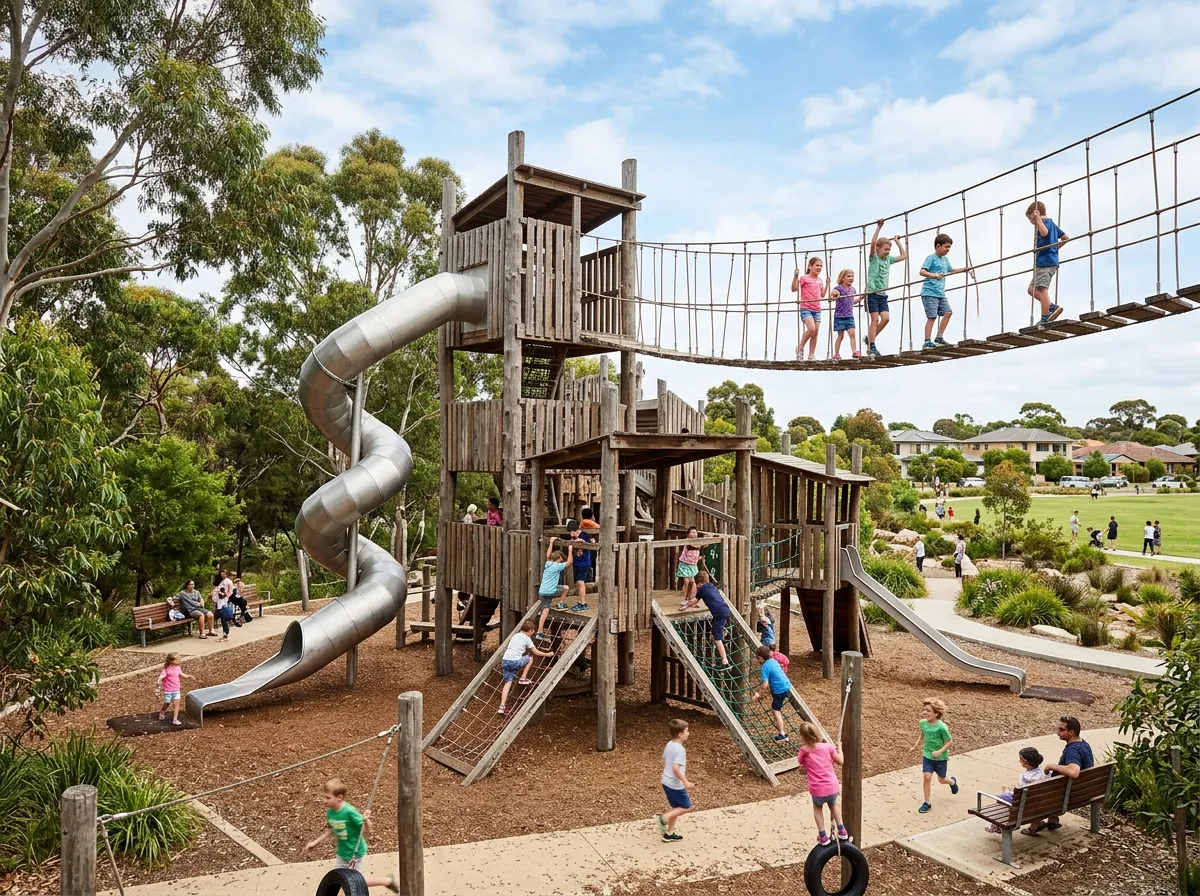
Destination playgrounds encourage cooperative physical play for school-age children. Multi-level climbing structures, flying foxes, and team-oriented equipment at places like Blaxland Riverside Park and Darling Quarter Playground create environments where children naturally team up and challenge each other. Check out our guide to the best playgrounds in Sydney.
Sensory play spaces are particularly good for children who are cautious or easily overwhelmed. The structured, contained nature of sensory play experiences means children can engage at their own pace. Sand, water, and messy play tables create natural parallel play opportunities for children who are not yet ready for direct interaction.
Whatever stage your child is at, the most important thing is regular exposure to other children in environments where they feel safe. Social skills are not taught in a single session — they are built over hundreds of small interactions. Browse the KidsPlaySpace guide to find play spaces near you, filtered by suburb, age, and venue type.
Get the best kids activities in your inbox
Weekly picks from local parents — new venues, seasonal ideas, and hidden gems across Sydney.
Get all the best ideas for your kids delivered to your inbox every week
Find Play Spaces Near You
Browse by suburb, age, and amenities
Own a Play Space?
List your venue free — reach local families
Frequently Asked Questions
About KidsPlaySpace Team
Written by our team of Sydney parents who visit and review play spaces across the city.