The Complete Guide to Early Learning & Childcare Centres in Sydney
Finding the right early learning centre in Sydney can feel overwhelming — there are thousands of options across the city, each with its own philosophy, fee structure, and waitlist situation. Whether you are returning to work and need long day care for your baby, looking for a preschool program for your three-year-old, or exploring alternative approaches like Montessori or Steiner education, Sydney has an incredibly diverse early learning landscape that caters to every family's needs and values.
The main types of early learning in Sydney break down into several categories. Long day care centres operate from approximately 7am to 6pm on weekdays and accept children from 6 weeks to school age — these are the most common option for working parents. Family day care operates from an educator's home with smaller group sizes (typically 4-7 children), offering a more intimate, home-like environment. Preschools (also called kindergartens in NSW) focus on 3-5 year olds and usually run shorter hours, often 9am to 3pm during school terms. Montessori centres follow Maria Montessori's child-led learning philosophy with mixed-age classrooms and hands-on materials. Steiner (Waldorf) centres emphasise creative play, nature connection, and imagination-based learning with minimal screen exposure.
The Child Care Subsidy (CCS) is the Australian Government's main payment to help families with the cost of childcare. Depending on your household income and activity level, the CCS can cover between 24% and 90% of your childcare fees, applied directly to your account to reduce out-of-pocket costs. For a family earning $100,000 combined, the subsidy typically covers around 72% of fees. To access CCS, you need a MyGov account linked to Centrelink, and both parents generally need to meet an activity test (working, studying, or volunteering). The Additional Child Care Subsidy provides extra support for families experiencing financial hardship, and the new higher CCS rates introduced in 2023 have significantly reduced costs for most families.
Sydney's early learning sector includes major providers like Goodstart Early Learning (the largest not-for-profit provider with dozens of Sydney centres), Only About Children, Guardian Childcare, and KU Children's Services. Community-based centres run by local councils and community organisations often have lower fees and strong local connections. Independent centres range from small family-run operations to premium boutique programs. Waitlists are a reality across Sydney — popular centres in the Inner West, North Shore, and Eastern Suburbs can have waitlists of 12 months or more, so registering during pregnancy is common practice.
When choosing an early learning centre, visit in person during operating hours to see how educators interact with children. Check the centre's rating on the Australian Children's Education and Care Quality Authority (ACECQA) website — ratings range from Working Towards to Exceeding the National Quality Standard. Ask about educator-to-child ratios, staff turnover, the daily program structure, outdoor play time, and how they handle transitions and settling-in periods. The best centres welcome parent involvement and communicate openly about your child's day through apps, photos, and regular developmental updates.
1. Types of Early Learning Centres in Sydney
Sydney offers a remarkably diverse range of early learning centre types, each designed to suit different family circumstances, philosophies, and budgets. Understanding the differences is the first step to finding the right fit for your child and your household.
Long day care centres are the most common form of early childhood education and care in Sydney. They operate year-round (typically 48-50 weeks per year) with extended hours from approximately 7:00am to 6:00pm on weekdays, making them the primary choice for families where both parents work full-time. Long day care accepts children from as young as 6 weeks through to school age (around 6 years), and centres are staffed by a mix of degree-qualified early childhood teachers and certificate-qualified educators. Daily fees in Sydney range from $120 to $200 depending on the suburb, with Inner City and North Shore centres sitting at the higher end. Long day care is eligible for the Child Care Subsidy (CCS), which significantly reduces the out-of-pocket cost for most families.
Family day care is delivered in a registered educator's own home, with smaller group sizes of typically 4 to 7 children including the educator's own children under school age. This model appeals to families who prefer a home-like environment with closer one-on-one attention, flexible hours (some educators offer early morning, evening, or weekend care), and a multi-age grouping that mirrors a family setting. Family day care fees are generally $90-$140 per day before subsidy, and it is fully CCS-eligible. Educators operate under a family day care scheme that provides coordination, monitoring, and support.
Community-based preschools (also called kindergartens in NSW) focus specifically on children aged 3 to 5 in the two years before school. They typically run during school terms only, with sessions from 9:00am to 3:00pm — some offer two, three, or five-day-per-week options. Fees tend to be lower than long day care, often $30-$60 per day, as many are run by not-for-profit organisations, churches, or local councils. The NSW Government provides free preschool for 600 hours per year for children in the year before school, which translates to roughly 15 hours per week.
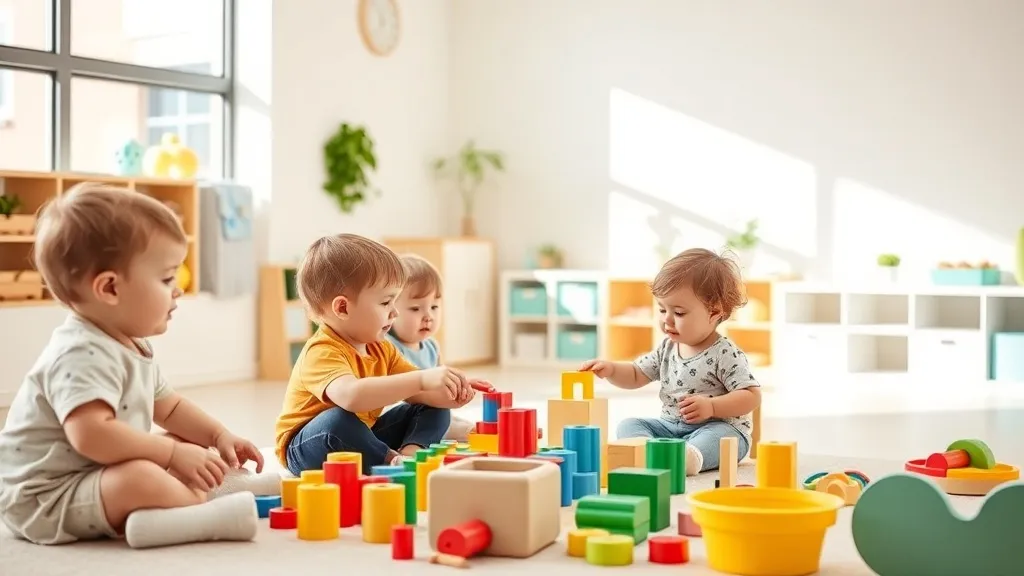
Montessori early learning centres follow the educational philosophy of Maria Montessori, emphasising child-led learning within a carefully prepared environment. Classrooms feature mixed-age groupings (typically 3-6 years), hands-on learning materials arranged on low shelves for children to access independently, and long uninterrupted work cycles where children choose their own activities. Montessori educators act as guides rather than instructors, observing each child and introducing new materials as the child demonstrates readiness. Sydney has Montessori centres across most regions, with fees at the higher end of the market ($150-$220 per day) reflecting the specialised training and materials involved.
Steiner (Waldorf) early learning centres take a different approach, prioritising imaginative and creative play, nature connection, rhythm and routine, and storytelling over formal academic instruction. Steiner philosophy holds that young children learn best through doing rather than being taught — so the curriculum emphasises handicrafts, watercolour painting, circle time with songs and movement, baking, gardening, and extended outdoor play in natural settings. There is deliberately minimal screen exposure and limited use of plastic toys, with classrooms furnished in natural wood and fabrics. Sydney has several Steiner centres, particularly in the Inner West, Northern Beaches, and Blue Mountains fringe.
Occasional care centres provide flexible, short-term care for children who do not attend a regular program. Parents can book sessions of a few hours at a time, making this model ideal for stay-at-home parents who need time for appointments, errands, study, or simply a break. Occasional care is CCS-eligible and fees are typically charged hourly ($10-$20 per hour). Availability can be limited in high-demand areas, so booking in advance is recommended.
2. Understanding the Child Care Subsidy (CCS)
The Child Care Subsidy (CCS) is the Australian Government's primary payment to help families afford early childhood education and care. For most Sydney families, the CCS is the single biggest factor in determining the actual out-of-pocket cost of childcare — so understanding how it works is essential.
The CCS is means-tested based on your combined family income. For the 2025-26 financial year, families with a combined income of $83,280 or less receive the maximum subsidy of 90% of fees (up to an hourly cap). As income rises above this threshold, the subsidy percentage gradually reduces. Families earning between $83,280 and $183,280 receive a subsidy that tapers from 90% down to 50%. Between $183,280 and $353,680, the subsidy tapers from 50% down to 20%. Families earning above $353,680 receive the minimum 20% subsidy. These thresholds are indexed annually and the exact figures may change, so check the Services Australia website for the most current rates.
To be eligible for the CCS, both parents (or the single parent in a sole-parent family) must meet an activity test. The activity test looks at the number of hours per fortnight each parent spends on recognised activities — paid work, study, training, volunteering, or looking for work. At the base level, 8 to 16 hours of recognised activity per fortnight entitles you to 36 hours of subsidised care. At 16 to 48 hours, you receive 72 hours. More than 48 hours of activity per fortnight entitles you to 100 hours of subsidised care. One parent in the household is exempt from the activity test if they earn less than $83,280 individually (as of recent changes that simplified access for lower-income families).
The CCS is paid directly to your childcare provider, reducing your fees at the point of billing. You will see the subsidy amount credited on your fortnightly statements, and you only pay the gap. To apply, create a MyGov account (if you do not already have one), link it to Centrelink, and lodge a CCS claim online. You will need your Tax File Number, income estimate for the current financial year, and details of your child's enrolment at an approved provider. Processing typically takes 2-4 weeks.
Beyond the standard CCS, the Additional Child Care Subsidy (ACCS) provides extra support for families experiencing temporary financial hardship, those transitioning from certain income support payments, and grandparent or kinship carers. The ACCS can cover up to 100% of fees in some circumstances. There is also the Inclusion Support Programme, which provides additional funding for centres to support children with disabilities or additional needs.
In practical terms, here is what the CCS means for a typical Sydney family. If your combined income is $120,000 and your long day care centre charges $160 per day, your CCS percentage is approximately 80%. The government pays $128 of that daily fee directly to the centre, and your out-of-pocket cost is $32 per day. Over a 5-day week, that is $160 out of pocket rather than $800 — a substantial difference that makes quality early learning accessible for most working families. Keep in mind that the CCS is calculated on an hourly rate and is capped at an hourly fee ceiling ($13.73 per hour for centre-based day care in 2025-26), so if your centre charges above the cap, you will pay the difference in full.
3. How to Choose the Right Early Learning Centre
Choosing an early learning centre is one of the most important decisions you will make as a parent, and it is worth investing time in the process rather than simply enrolling at the nearest centre with availability. Here is a practical framework for evaluating centres in Sydney.
Start by checking the centre's quality rating on the ACECQA website (acecqa.gov.au) or the MyChild portal (mychild.gov.au). Every approved early learning service in Australia is assessed against the National Quality Standard (NQS), which covers seven quality areas: educational program and practice, children's health and safety, physical environment, staffing arrangements, relationships with children, collaborative partnerships with families, and governance and leadership. Centres are rated as Working Towards, Meeting, Exceeding, or Excellent. Aim for centres rated Meeting or above — an Exceeding rating indicates particularly strong practice. As of 2026, approximately 30% of Sydney centres are rated Exceeding, about 55% are Meeting, and the remainder are Working Towards.
Visit your shortlisted centres in person during normal operating hours, not during a scheduled tour when centres naturally put their best foot forward. Arrive at drop-off time (around 8:00-9:00am) to see how educators greet children and families. Walk through each room and observe: are educators at the children's level, engaged and responsive? Is the environment calm or chaotic? Are children actively engaged or wandering aimlessly? Is there a balance of structured and free play? Are the outdoor spaces well-resourced with natural elements, not just plastic equipment?
Ask specific questions about educator-to-child ratios and whether the centre consistently meets or exceeds the regulatory minimums (1:4 for children under 2, 1:5 for ages 2-3, and 1:10 for preschool-age children in NSW). Ask about staff turnover — high turnover is a red flag as children thrive on consistent relationships with their caregivers. Enquire about the daily routine, meal provision (does the centre provide meals or do you need to pack food?), nappy and toilet-training policies, rest and sleep arrangements, and how the centre communicates with families throughout the day.
Consider practical logistics: proximity to your home or workplace, opening and closing times (and late-collection fees, which can be steep at $1-$2 per minute), whether the centre aligns with your work schedule (some preschools only operate school hours and school terms), and the fee structure including any additional levies for excursions, incursions, or consumables. Factor in the CCS to calculate your actual out-of-pocket cost.
Finally, trust your instincts. After visiting several centres, you will develop a sense of which environment feels right for your child and your family. A centre where the educators genuinely know each child's name, interests, and temperament — and where children are visibly happy, confident, and engaged — is worth prioritising, even if it is not the cheapest or the most conveniently located option.
“The main types of early learning in Sydney break down into several categories.”
Compare early learning Near You
Tell us where you are and we'll match you with the best options.
Listings coming soon — we're adding providers across Sydney. Subscribe for updates when they're live.
Get the latest early learning deals and openings
New venues, seasonal offers, and activity ideas — delivered to your inbox.
About Tamara
Sydney mum of two and founder of KidsPlaySpace. Tamara has visited hundreds of play centres, playgrounds, and kids venues across Sydney to bring families honest reviews and real recommendations.